Portal retrospective [PC/360/PS3]


The concept behind Portal began life as a final year project at the game design university Digipen called Narbacular Drop, put together by seven hard-working students under the name Nuclear Monkey Software. The game was spotted by Valve reps attending the university’s annual recruitment fair, after which the team were invited to meet with Valve co-founder Gabe Newell. Just 15 minutes into their presentation, Gabe asked the entire team if they wanted a job.
What the team managed to create during their subsequent time at Valve was in many ways a spiritual successor to Narbacular Drop. Portal employed the technology developed for that title and, with a narrative penned by Valve’s acclaimed writing duo of Chet Faliszek and Erik Wolpaw, laid heavy hints the new game was actually taking place in the Half-Life universe.
See, the chambers start out simply enough...
As a experimental subject (known only as Chell) for the mysterious Aperture Science corporation, you wake from stasis only to realise something’s gone very, very wrong. Aperture’s AI, the sinister GlaDOS, wants to put you through a strict testing regimen involving the company’s latest piece of kit but there doesn’t seem to be anyone else around, and said tests don’t seem to have your best interests at heart, to put it mildly. It soon becomes apparent as you make your way through the game that GLaDOS might, in all honesty, be barking mad. What on earth’s happened?
Portal’s big draw was the gadget you haul through level after level, the handheld portal device. If for some reason you’ve never seen the game running, think of portals as two separate sides of the same doorway. Fire the gun once, drop an orange portal – one side of the doorway. Fire the gun at something else, drop a blue portal – the other side.  These two could be far, far apart or the first could be on the ceiling, the second on the floor – either way, you stepped into one, and instantly came out of the other.
You had to overcome a score of self-contained puzzles, or test chambers, using this deceptively simple trick in steadily more mind-bending ways, often putting portals down in one place then switching them somewhere else multiple times to reach your goal.
...but then the puzzles got steadily tougher...
Tricks like this were a brilliant tech demo, not to mention a superb example of emergent design that would have been enough for many small developers to retire on. But again, it was Wolpaw and Faliszek’s writing that took Portal from a party piece to an absolute undisputed classic.
Portal can feel like something of a departure from traditional storytelling, but the team still demonstrate more of an ability to develop characters and build up a world than many novelists ever manage. Much of this was down to GLaDOS, surely one of the most well-realised villains in any medium, let alone games. Voiced by frequent Valve collaborator Ellen McLain, the malevolvent AI both paints a picture of why you’re here – what happened to Aperture Science – and adds a sense of urgency to the experience of play. For all of you who beat Portal, how far would you honestly have got without GLaDOS and her constant promises of cake at the end of the journey?
And she wasn’t solely mad, either. The slow realisation that builds over the course of the game is not just of how crazy GLaDOS has gone, but also how lonely she must be. Murderous and psychotic, sure, but still lonely. Ellen McLain’s superb performance under the FX on her voice, and the transition from stony artificial intelligence to – gasp – a rounded personality is, once again, a masterstroke. The constant (yet beautifully paced) stream of blackly funny quips are what many people remember most fondly of Portal – “Assume the party escort submission position” being one of my favourites.
...and then things start trying to kill you.
And yet! You could argue it wasn’t GLaDOS who stole the show. No, it was something so affecting it moved grown men – manly types with tool belts and hacksaws – to wipe their eyes and complain about all the dust in the air. So… a puppy, or adorable fluffy kitten, perhaps? No. It was a cube.
Now stop – stop. Seriously, don’t even go there if you’re about to tell me the cube meant nothing to you. All I can say to that is you’re most likely dead inside. Admittedly, the first sight of the Companion Cube was innocuous enough. GLaDOS presents you with it, saying you have to carry the thing through the next level. No big deal. Happens in loads of games, right? Ah, but wait… this cube has little pink hearts on it. Apparently beta testers were dumping the cube (originally blank) at the start of the level, and Valve wanted a way to make sure people remembered they had a silent little friend they were supposed to be helping through this particular puzzle. Kim Swift from the Portal team talked in interviews about how the cube’s new look was inspired by government research into deprived subjects creating attachments to inanimate objects: an appropriately creepy inspiration given how GlaDOS is constantly manipulating you.
That said, the moment at the end of that level when you have to face the inevitable is heart-wrenching. GLaDOS, clearly as mad as a sack full of badgers by this point, informs you regretfully your Companion Cube must be “euthanised” in an “emergency intelligence incinerator.” Well, it floored me. I literally stopped for five minutes, appalled that I had to destroy my only friend.
Aperture Science is definitely not a happy place. Or a sane one, looks like.
It was the way these things came together – like the genius of GLaDOS, the sparkling, jet-black humour in the dialogue, the unexpected attachment to an inanimate cube and, yes, that ending song (Jonathan Coulton’s superb Still Alive) – that made Portal more than just an eye-catching concept. However innovative the mechanics, a blank physics playground would surely have never stood up over a longer period. Ditto GlaDOS and Aperture Science; without portals and the structure of a science lab, they wouldn’t have stood out half so much.
Sure, there were plenty of negative reactions to it not taking very long to finish, but as Erik Wolpaw notes himself, “without the constraints, Portal would not be as good a game.” It’s hard to disagree, not least when the end result is heaven on a DVD-ROM. Those two, three hours delivered more inventiveness and emotion than a dozen blockbusters stuck together.
And yet now Portal 2′s about to be released, and it’s looking as if Valve have done even better with the idea the second time around. I can hardly wait for it to arrive. We’re going to have fun… with science

NUTS: Companies Jockey for Cloud, Mobile Payments


NUTS: Companies Jockey for Cloud, Mobile Payments

By Kendra Srivastava | Sat Apr 16, 2011 8:00 am
LG Thrive

LG Thrive

HTC Sensation

HTC Sensation

Nokia E6

Nokia E6

Nokia X7

Nokia X7

Apple, Google and Amazon are competing for cloud services, while American Express and Google made a push into mobile payment systems, foreshadowing a future without credit cards.


Top News


NUTS: Companies Deal With Lawsuits, Privacy Issues

What's Your Price to Quit Facebook?

IPod Accounts for One-Third of Apple Sales

Mac Versus PC: What Your Computer Says About You

AT&T Defends T-Mobile Merger

More News >
News Under the Sun is a weekly column rounding up all the events on in the mobile industry. Want the news but don't want it every day? Subscribe to our weekly Facebook or Twitter page.

Apple, Google Neck and Neck

The competition between Apple and Google shows no sign of slowing down. Apple's growing market share in mobile ads will soon challenge Google's current 48 percent, Millennial Media reported Thursday. Google will remain ahead for the time being, riding the the Android surge, but Apple's top position in app revenue will likely draw more ads as developers favor the more lucrative platform.
Challenging Apple for business customers, Google unveiled its "Google Apps Device Policy," which beefs up security by encrypting data and letting users find lost devices. Apple already offers such services and has a larger share of the enterprise market, but Google's new policy may help Andriod push into businesses.
But even as they battle each other, Apple and Google are both beating Nintendo and Sony with higher game sales on their mobile devices. Smartphone games cost much less than traditional hand-held games and are squeezing dedicated mobile game devices despite Sony and Nintendo’s best efforts, according to a survey by Flurry.

Three Companies Compete for Silver Lining in Cloud

In the race to dominate the cloud, or online computing and storage services, Apple beefed up hiring for cloud developers, signaling the company's readiness to compete with similar offering from Amazon, which lets users store music online and access it from any device.

Also in the cloud race is Amazon, which insists its Cloud Drive is purely a storage service and therefore needs no licenses from the music industry to stream content to users.
Amazon defended this view to music industry representatives in a meeting on Thursday. The outcome of these talks could affect the future of cloud streaming services; Apple and Google, which aim to offer similar cloud services, will be watching closely.
With its eye on the cloud as well, Google acquired PushLife on Monday, hinting at future cloud music service ambitions. PushLife's technology could allow Android smartphone users to sync their music collections to other libraries and to store tunes on the cloud. It's rumored Google is already testing Google Music internally, a service that would rival Amazon's Cloud Drive and Apple's coming cloud offerings.


AmEx, Google Expand Mobile Payment Networks

American Express announced it has started developing payment systems for smartphones and other mobile devices. AmEx is now the chief investor in Payfone, suggesting the credit card company sees a future in mobile phone payments.
Google is also experimenting with the mobile payment business. The company posted "smart" store stickers in four cities, letting users "check into" businesses with the wave of a phone.
This trial run may pave the way for Google to create an NFC-powered mobile payment system; it's already in talks with MasterCard and Citigroup to make this dream an eventual reality.

Government Gets Involved in Internet Privacy, Mobile Spectrum

The U.S. government sought both to regulate how companies user customer’s personal information and to open up mobile spectrum this week. Senators proposed a Privacy Protection Bill that would require Internet companies to seek permission before distributing personal information to outside parties. Microsoft, HP, eBay, and Intel praised the effort, while some consumer advocacy groups are still pushing for stronger privacy protection.
This while the FCC is calling for more spectrum for mobile devices. The agency wants television broadcasters' spectrum to be auctioned off to companies like AT&T that a facing congested networks due to spectrum limitations.

New Mobile Phones on Market

Of the several new phones on the market this week, AT&T's LG Thrive is the first prepaid smartphone from the company. It could help AT&T after its loss of iPhone exclusivity to Verizon by luring customers who don't like long-term contracts.
HTC also unveiled a new phone, the Sensation 4G for T-Mobile. The Sensation features a concave, scratch-resistant Gorilla Glass screen and an aluminum case which gives it the sleek appearance of worthy iPhone opponent.
Nokia's latest offerings, the E6 and X7 Symbian-based phones, may be the last of their kind before the company transitions to Microsoft’s Windows Phone platform.
And last but not least, Apple is expected to release a white iPhone later this month. It won't include new features aside from the color, but it may steer buyers away from Android phones while Apple readies its iPhone 5 for later this year.

Apple Sued by Angry Parents, Introduces IOS Updates and More

Apple was sued by angry parents over in-game iPhone purchases this week. Led by a man whose 9-year old racked up a bill for $200 worth of virtual goods, the suit alleges that Apple's in-app purchasing policies don’t stop children from abusing their parents' credit cards.
Apple also released iOS update for the iPad, iPhone, and the latest generations of iPod Touch. The update fixes bugs and patches holes like frozen FaceTime screens and 3G connection issues. The next overhaul to come will be iOS 5, expected this fall.


Google's New Headaches

Google didn't have the best news week. On Friday, a problem in Skype for Android was discovered that could have allowed malware to steal personal information from unprotected smartphones, another ding in a string of security-flaw-related stories for the company.
Google also faces problems in South Korea, where two search engines accuse Google of squeezing them out by making deals with phone makers to block the pre-installation of other search engines on Android handsets. This adds to Google's numerous antitrust investigations by various regulatory bodies, national and international.
If all this weren't enough, Google's profits fell short of expectations. Though up 18 percent, its investments, along with high operating costs, cut into profit margins more than investors would have liked.


Microsoft's Latest Misfortunes

Though it had promised updates to Windows Phone 7 in January, Microsoft is delaying the improvements because of hardware issues. Lagging in the smartphone game, Microsoft is trying to catch up both by marketing its own phone and also by partnering with Nokia to install Microsoft's OS on the Finnish company's mobile devices later this year.
Microsoft also received bad press this week when a former employee was arrested for defrauding the company of $460,000. The FBI says Robert D. Curry took checks meant for Microsoft from Pentad Solutions and used them to buy a ski-vacation and invest in audio equipment, among other misuses of the funds.


AT&T, T-Mobile Merger Senate Hearing Scheduled

AT&T's planned $39 billion merger with T-Mobile, announced in March, will receive a Senate hearing next month. The Judiciary Committee will scrutinize the deal and decide whether it would make AT&T too powerful.
AT&T says the merger will benefit customers by providing faster and wider network coverage; detractors say this combination will give AT&T and competitor Verizon a virtual duopoly on the mobile market.


HTC's Improved Sense Software May Help it Stand Out

HTC has improved its Sense user interface for its Android-based devices, in an effort to differentiate itself from other hardware companies on the market. The new software will allow users to take better photos, manage ringtone volume based on the phone's position, and use improved lockscreens, among other things.


Motorola, Huawei End Courtroom Battle

Motorola and Chinese manufacturer Huawei dropped ongoing lawsuits on Wednesday, settling an intellectural property dispute and allegations of industrial espionage on undisclosed terms.
Their battle highlights the prevalence of courtroom drama among technology companies: Motorola and Microsoft are suing each other while Nokia is suing Apple and Apple is suing Amazon.


Sprint's Music Plus Launched Tuesday

Sprint's new Music Plus, a service for Android phones, may face an uphill battle against competitors like iTunes and Amazon's Cloud Drive. With everyone trying to grab a piece of the online music industry, Music Plus is not alone and will need to differentiate itself to survive.


T-Mobile's Rumored $60 Data Plan Never Arrives

T-Mobile leaked information about a possible $60 per month data plan that would have been unveiled on Thursday. But the plan never materialized, possibly because it was simply too good of a deal.
Some wonder if such low-cost contracts will ever become available if T-Mobile merges with AT&T; this possibility seems unlikely given that AT&T will probably not adopt T-Mobile's cheaper pricing.

YouTube Snagger, Download YouTube HD Videos

Computer users have dozens of options when it comes to downloading videos from the world’s most popular video hosting site YouTube. From browser extensions over userscripts to standalone software programs that vary in comfort and features. Check out our download YouTube videos guide for a selection of the best available tools to snag videos from YouTube.
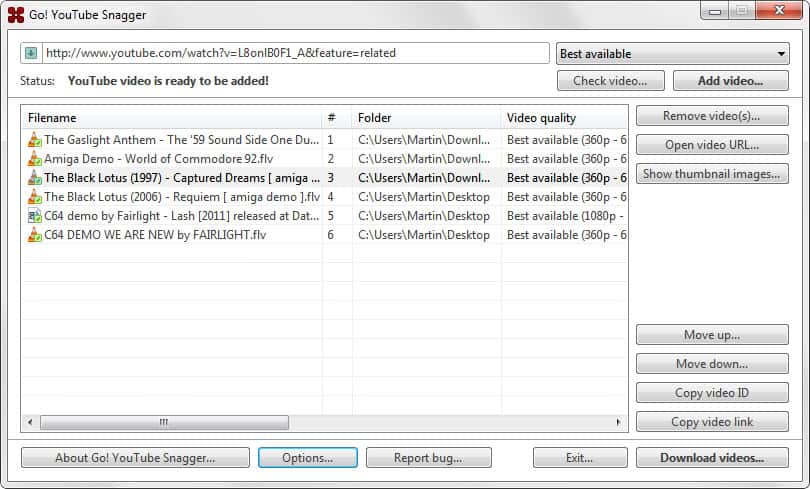
YouTube Snagger is a standalone application for Windows that can be used to download videos from YouTube. The program does not offer a search which I personally see as a big negative, as it means that you need to open a web browser, copy the web address of a video that you like to download, paste it into the application’s interface before you can start configuring the download options and download the video.
A search simplifies the download task considerably and tools like TubeQueue or Free FLV Converter show how its done (check the guide linked above for links). That’s however the only negative as far as this review goes.
YouTube Snagger’s interface has been streamlined for quick downloading of videos. You paste a Youtube video url into the form at the top, select the desired video quality (for instance best available or 4096p) and click the Check Video button afterwards. The program tries to pull data from YouTube and either returns the status that the video can be added or that no video has been found. You need to click on Add video to add the video to the download queue.
download youtube videos
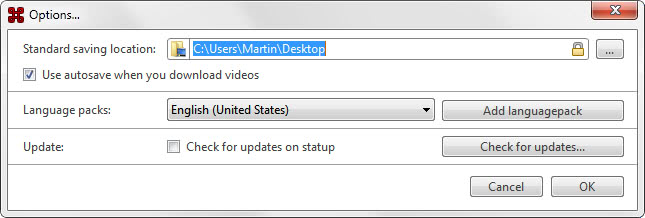
A download window will pop up where you need to select a download location on the local hard drive. You can visit the options later to configure the program to bypass the download dialog. New video downloads will then be saved automatically to the standard save location selected in the options.
youtube download options
It would have been nice if the developer would have added an option to automatically start the download, for instance if check video found a video on the pasted url. This would make the whole process more comfortable and reduce the button clicks considerable.
All YouTube videos are listed with their filename, download folder, quality and video title in the program window. This window acts as a queue, and videos are not downloaded until you hit the Download videos button at the bottom right of the screen.
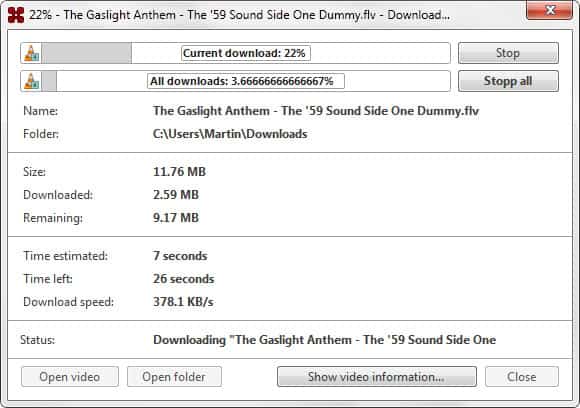
This spawns a new window that displays the download progress, speeds and overall progress.
download videos
It is unfortunately not possible to use the main interface while the download window is open. Make sure you have added all the videos that want to download from YouTube before you hit that download videos button.
If you look at the positives you find a responsive application that can download multiple videos from YouTube in a quality that you specify.
The things that take it down a notch are the missing YouTube search option, the to many buttons in the interface, no option to play a video from the interface, or at least launch it in the default player, and that downloaded videos do not get removed automatically from the queue.
You can download the latest version of YouTube Snagger from the developers website.

Reconnect

Shah Rukh Khan & D ShivakumarAt the launch of the company’s latest communicator device E7, D Shivakumar, managing director and vice-president for Nokia India, was inundated with questions from the media on Nokia’s steady decline in market share and gradual increase of Android’s — Google’s open source mobile operating systems — share in India. But Shivakumar displayed no signs of irritation while he patiently addressed journalists’ queries.
A calm-looking Shivakumar refused to fidget even when a video call demonstrated on the E7 device failed to run during the press event. He instead got company’s brand ambassador Shah Rukh Khan to address the media about the newest device and his experiences with the E7. In simple words, managing the media and its queries now comes easily to Shivakumar: after all, he has been managing the India business for the Finnish company for about five years.


Nokia’s To-Do list
  • Low overall mobile penetration indicates a latent potential for growth in India. This is especially true for expansion opportunities in the rural and semi-rural markets, which currently have low teledensity. Nokia plans to launch dual-SIM handsets at the entry level, priced below Rs 4,000.
  • The growth in the Indian mobile handset market is likely to be driven by the replacement handset market rather than new user additions. Nokia intends to position itself as a brand that can be trusted for its customer service and products, and thus ensure repeat purchases.
  • As average revenue per user declines and voice gets commoditised, both handset manufacturers and operators will need to develop value-added services so as to create high-yielding revenue streams, and attract as well as retain customers by creating a basis for differentiation. Nokia is building an array of services like music, social networking, games, utility and productivity tools (for example, Nokia Life Tools) and has tied up with banks for mobile banking.


But behind a facade of calm Nokia is preparing for a bitter battle for market shares. While at the lower end of the market, smaller local manufacturers are giving the world’s top cell phone maker a run for its money, at the upper end — in the critical smartphone segment — Nokia is struggling against stiff competition from innovative software makers Apple and Google. It is the availability and success of Google’s free open source Android platform that has made entry and expansion in the smartphone market easier for a number of hardware manufacturers in India which have chosen to join Android’s ecosystem, especially at the mid-to-low range of the smartphone market. This is where Nokia has been hit the hardest.
A comeback is being planned at Nokia. In India, Shivakumar and his team are busy pushing out services and utility tools on mobile devices that will improve the user interaction with the internet. “We have added 5 million songs on our music service, introduced accurate real time crop data for farmers at Rs 30 per month, bundled data plans with handsets to encourage free surfing on mobile, and even introduced social networking phones at the mid level,” lists Shivakumar. The company is now eyeing the replacement market that is expected to get people to switch to bigger “trustworthy” brands like Nokia.
“It’s time we leverage our market position and brand in emerging markets to increase sales here,” says Shivakumar. Nokia India, which is second biggest market for the company after China, contributed ¤2,809 million (Rs 18,000 crore) to the company’s worldwide sales in 2009.
To put things in perspective, the Indian mobile handset market has grown by 30.17 per cent from 116 million handsets as on December 31, 2008, to 151 million handsets as on December 31, 2009, as per Analysys Mason data. The growth has been driven by the growth in mid-priced devices — in the range of Rs 2,000 to Rs 5,000.
Market research firm CyberMedia Research recently released a report that predicted the Indian mobile handset market to grow 25 per cent by volume in 2011 to 210 million units with smartphones contributing sales of nearly 12 million units in 2011. “Smartphones are mobile devices with evolved operating systems, that include Symbian Series 60, Android OS, iPhone OS, Blackberry OS, Linux among others,” says Siddharth Neri, analyst, mobile devices research, India telecoms practice at CyberMedia Research.
Nokia’s India act
Having seen a market share erosion of more than 40 per cent in the last three years in India, Nokia is keen to uphold itself as a brand that can be trusted — a direct answer to naysayers who suppose the local handset brands have eaten into Nokia’s share at the entry level. This also explains why the Finnish giant is wooing popular Bollywood stars like Shah Rukh Khan and Priyanka Chopra as the brand ambassadors for its devices who can communicate the “trust” factor to the consumers. Shah Rukh Khan, who reportedly tested the E7 before it was launched, is seen promoting the device on ad breaks during the Indian Premier League telecast on television.
But smart marketing will not alone save Nokia and the company knows that. That’s why Shivakumar says, “Nokia excels at providing low-cost handsets in high volumes — affordable, simple user interfaces and handsets with software that one can consume and not just fancy.” Nokia claims that it has fine-tuned its approach for the entry level. “We will launch several low-cost dual SIM handsets with features like camera and radio that are much in demand,” says Shivakumar.
Nokia can take comfort in the fact the brand still rules over the mobile handsets market in India with a 56 per cent top-of-mind recall followed by Samsung and then LG. As per the Mobile Handsets Usage And Satisfaction Study 2011 of over 4,425 respondents conducted by CyberMedia Research, Nokia remains the most well recognised brand in terms of ‘total awareness’, but emerging Indian brands like Micromax and Spice too have managed to attract a large following.
But competition is breathing down Nokia’s neck. At last count, well over 200 mobile handset brands were available at retail outlets across the country, according to CyberMedia Research (CMR). According to Anirban Banerjee, associate vice-president, research and consulting, CMR India, “Indian handset buyers are increasingly more feature conscious, applications aware and value conscious, rather than being plain ‘brand loyal’ in the traditional sense of the term.” He adds, “Emerging mobile handset players with their highly innovative features have been able to influence the first time buyers, especially the youth and blue collar executives.”
It is not only competing with established brands like Research in Motion, the maker of BlackBerry, Apple and Samsung, but Nokia has to also beat the threat from smaller local players, who have unleashed a virtual tsunami of copycat models with almost similar features that match those of high-end branded models, but at much lower prices. Result: Brands like Micromax, GFive, Spice, among others have already grabbed a sizeable chunk of the domestic handset market.
Korean electronics giants LG and Samsung have already upped their R&D focus to make value additions for Indian mobile users. Samsung says it has made significant investments in its software R&D centre in Noida and has a team of 20 engineers working on customising smartphone platforms for Indian users. Samsung India Software Operations Vice-president Dipesh Shah says, “We are sure to capture a market share of at least 40 per cent in 2011.”
Shah is hopeful that the company’s Andriod-based smartphones as well those running on Bada, its own mobile operating system, will provide the brand enough differentiation to give it a big market push in 2011. The confidence stems from the fact that Samsung puts over 8 per cent of its global spends into R&D every year and India is amongst the only four markets to have a dedicated product innovation team outside the US, UK and China.
LG, too, is betting big on smartphones. It plans to launch 10 handsets under its Optimus smartphone brand this year, which will include a 3D phone as well as a dual-core processor (faster processing power) phone. “With Optimus models we will have smartphones in the high end as well as for the first-time smartphone users. Since the demand for smartphones is accelerating with 3G in India, LG expects to generate 20-25 per cent revenue from new smartphones,” says Vishal Chopra, business head, mobile communications, LG India.
Nokia had announced its new strategy, leadership team and operational structure for devices and services business on February 11, 2011, designed to focus on speed, results and accountability. Effective April 1, 2011, there will be two business units: Smart Devices, focused on smartphones, and Mobile Phones, focused on mass-market mobile phones. “The new strategy also involves changing our mode of working and culture to facilitate speed and agility in our innovation, product development and execution and accountability for results,” lists Shivakumar.
The Micro (soft) bite
Last month, a broad strategic partnership was announced between Microsoft and Nokia. Microsoft’s Windows Phone would serve as Nokia’s primary smartphone platform, announced Nokia’s new CEO Stephen Elop, himself an ex-Microsoft employee. “A renewed approach to capture volume and value growth to connect ‘the next billion’ to the internet in developing growth markets,” underlined Elop.
What he didn’t say was that other smartphone platforms with their related ecosystems have continued to gather momentum and market share, specifically Apple’s iOS proprietary platform and Google’s open source Android platform. Until very recently, Nokia believed its competitive position in smartphones could be improved with Symbian — that’s when it launched the Nokia N8 device that supported Symbian 3 OS. Shivakumar too concurs that for the long term the Symbian platform will not be sufficient in pocketing the smartphone users.
Last month, Nokia even outlined the risks of its decision to partner with Microsoft, in a regulatory filing highlighting many of the issues raised by critics, primarily the hiatus period before it can launch devices running Windows Phone 7 (WP7) — a period that condemns the company to another year in the smartphone wilderness. Nokia says it is aiming to expand the Microsoft operating system into mass markets, and even wrote in the regulatory filing that “This strategy recognises the opportunity to retain and transition the installed base of approximately 200 million Symbian owners to Nokia Windows Phone smartphones over time. We expect to sell approximately 150 million more Symbian devices in the years to come, supported by our plan to deliver additional user interface and hardware enhancements.”
Other risk factors highlighted by Nokia include the relative immaturity of the Windows Phone 7, a mobile operating system developed by Microsoft as the successor to its Windows Mobile platform. “The Windows Phone platform is a very recent, largely unproven addition to the market focused solely on high-end smartphones with currently very low adoption and consumer awareness relative to the Android and Apple platforms, and the proposed Microsoft partnership may not succeed in developing it into a sufficiently broad competitive smartphone platform,” says the document, which acknowledges that other “more competitive alternatives” might have delivered market share more rapidly.
Back in India, Shivakumar does not even bat his eyelids as he replies to a query on effect of the partnership in India. “It’s a win-win deal,” he quips. “India is set to become a 4 million unit smartphone market by 2014 and the Windows 7-Nokia platform is intended for the smartphone devices.”
And while Shivakumar admits that older mobile operating systems like Symbian didn’t stand a chance against new mobile OSes like Android and Apple iOS, Nokia is certain the new Windows 7 platform will be the key to winning the smartphone battle in India.

Online Crime’s New Frontiers

Las Vegas, Nevada (NAPSI) - More than ever, Americans are using new gadgets for entertainment, to communicate with friends and family and to perform their jobs. Thanks to technological advances, streaming movies, downloading music and e-mailing can be done with the tap of a finger.
Two of the most popular technology trends over the last couple of years are the ever-increasing use of mobile devices, like smartphones and tablet computers, and social networks. Together, the improvements have allowed people to broadcast information and interact with their friends and family, anywhere and anytime.
Unfortunately, while new devices and new ways of connecting have made getting online much easier, they’re also providing cybercriminals with new, creepy ways of targeting victims. As more people use their “smart” devices to access the Internet and stay up-to-date with their social networks, online thieves have more opportunities to steal personal information, which can then be used or traded for their financial gain.
Norton by Symantec, the makers of Norton Internet Security, recently released its 16th Internet Security Threat Report. Among the top findings, the report revealed that mobile devices and social networks are among the hot new targets for crooks looking to make a quick buck.
One of the latest scams involves cybercriminals taking popular smartphone applications (or “apps”) and creating “poisoned” versions. The versions may look like the originals but after unsuspecting users have downloaded them, a number of things can happen—potentially damaging or dangerous software may be installed onto your phone, unnecessary personal information may be requested or the application (and the cybercriminals controlling it) may be able to see and even control all your mobile phone activity.
“Many people aren’t even aware that these kinds of mobile threats exist,” said Adam Palmer, Norton’s Lead Cybersecurity Adviser. “Taking precautions can be as simple as using a mobile security application and sticking to legitimate app marketplaces.”
On social networks, once a cybercriminal has access to someone’s account, he or she can post links to other websites on the victim’s profile. These links will show up on the news feeds of the victim’s family and friends and lead them to infected sites with viruses and other nasty items. The popularity of using shortened links also works in the scammer’s favor, since people aren’t able to easily tell if the link connects to a “bad” site. According to the Symantec report, of the total number of dangerous links found on social networking sites, 66 percent of them were hiding in shortened links.
Whether you are on a mobile phone, social network or just surfing the Web at home, it’s important to remember that cybercrooks are constantly stepping up both the complexity of their attacks and the ways they target victims.
Here are some tips you can follow to protect yourself:
• Use security software on your computer and your mobile phone.
• Be cautious when clicking on links in e-mails, instant messages and social networking sites—even when coming from trusted sources, like friends and family.
• Limit the amount of personal information you make publicly available on the Internet (especially via social networks), as it may be collected by cybercriminals and used to scam you.
For daily updates on cybercrime and what you can do to protect yourself, visit www.NortonCybercrimeIndex.com.

ENJOY THE ULTIMATE ID WEB FLOODER FOR NIMBUZZ CHAT ROOM

CLICK ON THE LINK TO ENJOY THE ULTIMATE ID WEB FLOODER FOR NIMBUZZ CHAT ROOM
INDONASIAN FLOODER
http://nimbuzz.x10.mx/

COOL INDO FLOODER FOR NIMBUZZ CHAT ROOM AND PVT

CLICK ON THE LINK TO ENJOY THE ULTIMATE ID WEB FLOODER FOR NIMBUZZ CHAT ROOM
INDONASIAN FLOODER
http://nimbuzz.x10.mx/